


What I learned from my grandmother
By Richard Reiss August 6, 2024
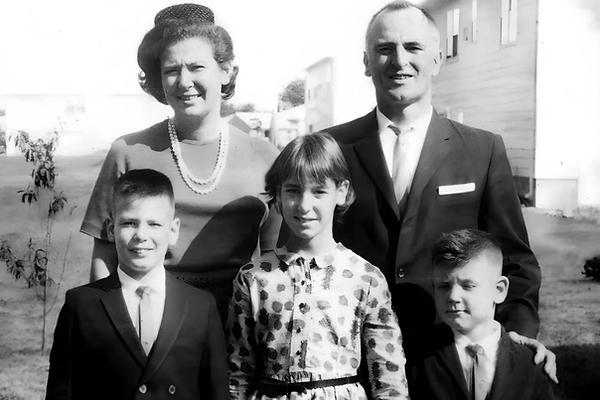
Richard Reiss, bottom right, is seen in a 1962 family photo standing in front of his father.
My father died 16 years ago. Were he alive, he would have turned 101 this week. Despite writing extensively about my kids, my wife and my mother, I’ve written practically nothing about him. The one and only time I did was at the request of my mother, who insisted that as the writer in the family, I give my father’s eulogy. Reluctantly, I obliged. This is what I said:
My father preferred The Three Stooges to the three tenors, the Mets to the Yankees and the Giants over the Jets. He taught me how to put a worm on hook, how to ride a bike and how to throw a ball.
He wanted both his sons to be baseball players and we both chose to be wrestlers, which might tell you a little bit about his children.
He was a passionate man for the things he cared about. He often screamed at the television set during a baseball or football game, a trait that he unknowingly passed on to me.
He was competitive. He liked to win, whether it was at the kitchen table playing Monopoly with his children, or in the court room, or a simple chat about anything with anyone, his competitive spirit was his hallmark. He could have debated Einstein about the theory of relatively and would surely have worn him down and proven him wrong.
My father was a little bawdy. He was a big fan of Benny Hill, the British (bawdy) comedian. I remember that one summer when I was 17, he asked me if I wanted to go to a barbecue. I had nothing to do and said, “Sure, why not.” So, I’m eating a hot dog and drinking a beer when suddenly I hear music begin to play. I turned toward the music that was coming from a big stage in an open field, and there on the stage was a very buxom woman in very tight nurse’s uniform, dancing with a six-foot inflatable hypodermic needle. It was a very special father and son moment.
My father liked to tell jokes, the kind of jokes where a person slipped on a banana peel. He liked to laugh; he enjoyed a good time. With my mother he traveled the world. His life was rich and full.
As he got older, he became a bit of a storyteller. He was a World War II veteran serving in the Pacific theater as a dental assistant in a M.A.S.H. unit before they were called M.A.S.H units. He told me how he landed on the beach but there was no one there to defend the island. He told me how he scouted for the enemy, but the enemy was not to be found. He told me that once he went on a really long hike and it was really hot, and he was really scared but nothing really happened. He was extremely proud to have served his country and, if nothing else, World War II taught him that he didn’t want to be a dentist like his uncle.
His greatest passion was his family. He was a devoted son who called his father every day before he left work and took care of his sick mother until her illness became more than he or my mother could handle.
He was a strong man. In some way he was indomitable, which according to my thesaurus (because I wasn’t sure if this was the word I was looking for, but it was) means unconquerable, resolute, determined, tough and spirited.
I learned from my father that you go to work in the morning, come home in the evening, take care of your family, cherish your friends and your loved ones, and become a responsible and contributing member of society. I learned all this not from what he told me but from what he did.
I’d like to say I miss him, but I don’t. I rarely think of him and, since his funeral, I have only been to his grave once, when I buried my mother beside him. The other part of the story is that he was mean and abusive. He struck me often as a child and was constantly yelling at my mother, whose devotion I never understood. My childhood was filled with fear and the secret wish that my mother would leave him and take me with her.
Recently, I was having dinner with a friend who told me that his father, too, was unusually cruel. I ask my friend if now, all these years later, he had forgiven him. To my surprise, he said, “Yes. There’s no point in carrying around all that anger. It serves no purpose.” And that’s where we differ.
I’m sure there are myriad complicated Depression-era reasons why my father was the way he was. Likewise, I’m sure there are myriad complicated baby boomer reasons why I am unmoved by them. I know he was proud of me; he often said so. And I know that he loved me, because he told me many times as he got older.
Nonetheless, his death elicited little emotion in me.
I was the last member of my family to see my father before he passed away. He had fallen, broken his hip and was living at the rehab where he was getting physical therapy. One evening, I said to my father, “Your birthday is coming up.” He said, “That’s right, I’ll be 65.” I said, “No, Dad. You’ll be 85.” And then I said, “I need to go.” And then he said, “Can’t you stay a bit longer?”
I didn’t. That night, he passed away in his sleep.
None of the men in my family have lived beyond 85. My father missed it by a few weeks. I’ve got 18 years to go, but I’m hoping I might beat that number. If I do, I will have finally topped my father. I can’t say how I will feel when and if that happens, but I’ll take my wins where I can. It’s a small life-over-death victory, but it might just be what I need to put my mind at rest before the same is done to my body.