


'Paula, I will be there when you fall. I will be there when you rise'
By Richard Reiss October 19, 2019

Squaw Peak, the rocky face near the summit of Monument Mountain in Great Barrington, was the spot where Paula Kaplan-Reiss lost her footing and tumbled 75 feet in August She suffered several broken bones and a concussion, but has mostly recovered from the injuries.
HEATHER BELLOW - THE BERKSHIRE EAGLE
Dear Paula: My memory of the exact moment you fell is not wholly clear.
What I remember is we were coming down off the mountain. It wasn't even a big mountain. At 1,642 feet Monument Mountain is officially a hill. A mountain must be at least 2,000 feet high. I was walking ahead of you, two or three steps ahead. I think I heard you call out my name, but I wouldn't swear to it. Something did make me turn around. Was it your voice?
All I know is when I turned around you were gone. There were others on the mountain, and I heard someone shout, "I'm calling 911."
I looked to where you were and saw that the dirt must have given way on the edge of the path. Your right foot slipped, and the rest of your body fell 75 feet to the rocks below.
I screamed, "Paula! Paula! Paula!" as I scrambled along the narrow path, looking over the side, desperately waiting for you to answer. The trees beyond and below the path were thick, and the brush that grew on the cliff prevented me from seeing anything other than forest. For five minutes, I called your name. No answer. Then I stopped and called again, but the only response was the rustling of leaves.
My mind was racing. Should I stay on top of the mountain to show the rescuers where you fell, or run to the bottom and tell them there? If I went to the bottom, who would show them where it happened? And what if you were dead? How would I tell our children, our friends and family? How would I live without you? Were you in pain? Were you crying? If you were alive, what could you possibly be thinking?
I prayed. I said the Sh'ma, the Jewish prayer that affirms a people's allegiance to the God that let this happen. Hear oh Israel the Lord is our God, the Lord is one. Praise be God's name for ever and ever. Please don't take this good woman. I'm not ready; the boys are not ready; SHE is not ready.
There were others on the mountain. A woman cautioned me, "Be careful, you may be going into shock." I remember saying sternly, "I am not going into shock!"
I tried to climb down the ledge to where you fell. It was steep and slippery from loose dirt, dead roots and thin branches. People told me not to do that, but how could I do nothing? You are my wife! How could I face our boys if I was nothing more than an observer? How could I look in a mirror?
I climbed down about 10 feet. Beyond that there was nowhere to go, nothing but trees and silence. We love these verdant hills. We spend so many hours upon hours celebrating their beauty. Would nature be so cruel?
I crawled back up to where I could stand. I yelled one last time, "Paula! Paula! Paula!" When the silence repeated itself, I decided to go down the path to the base of the mountain where our hike began.
By now, there would be a full team of rescuers in the parking lot at the trailhead. I asked a young man who I think saw you fall, if he would stay and show the rescuers the exact spot. He said he would and I ran.
From top to bottom is roughly a mile and half. The path is wide and only steep in few short sections. I passed hikers going up, smiling, holding hands, ready to photograph the wonderful rock formations at the summit that earned the mountain its name. I was running on and off, careful not to fall.
As I neared the bottom, a woman called to me. "My son found your wife." I stopped, breathless. "Is she alive?" I asked. "Yes," she answered, and I started to run again.
When I got to the parking lot, it was filled with emergency vehicles. Black and white police cars. Red fire trucks. Blue ambulances. Cars and SUV's of all colors belonging to the emergency responders from surrounding towns. In all, 50 people attended to your rescue.
It seemed so simple to me: climb to you and bring you down. Yet from the time you were found, to the time you were brought to the staging area, more than four hours passed. The young man who found you, Henry, directed the EMTs to your position. You were not easy to reach. You had fallen into an area far from any path, above dangerous and loose rocks. Your position was precarious. You could fall even further.
I tried to get information from the police, the emergency responders, the firefighters, anyone. They were polite, told me what they knew, but clearly wanted me out of the way. At one point I said, "I'm not leaving. Deal with it!"
A seemingly empathic police officer pulled me aside. He asked me a series of simple questions that others had asked me before. He moved me away from the staging area, but soon I moved myself back. Then I overheard a radio call from the EMTs, "Her pulse is weakening, you need to hurry."
I voluntarily walked away. I sat on a picnic table with my head in my hands. The mother of the boy who found you approached and asked me if I wanted to talk. You know me pretty well, so you can guess my response. "No."
I had to tell the boys. I needed them to know what was happening. If you were dead, I couldn't tell them over the phone. They were just getting over the death of your mother, whom we buried less than one week before.
I tried to explain. I was very calm, I did my best to keep my emotions in check. Ethan and Elijah could drive to the Berkshires from New Jersey. "Don't rush," I said. "Just get here."
Gabe, I knew would be harder. When I told him what happened he broke down. He's always been more emotional. I said, "I need you to be strong. Times like this define us as men. I'm sending you money. Book a flight from Atlanta and get here tonight if you can." He got it together and arrived at midnight.
The EMTs stabilized you, and more than two hours after you fell, the rescue team left the staging area. Their plan was to rappel down the mountain, secure you in a basket, pull you up, and bring you to the staging area where our hike began.
And that's what happened. Two hours later, you and I were in a helicopter, soaring over our beautiful Berkshires toward the trauma center in Albany, N.Y., located in the same hospital you were born in nearly 60 years before.
Despite a broken leg, major head contusions, 10 broken ribs, and a broken collarbone, you were never unconscious. Your incredible spirit, which has weathered more than its share of tragedy, showed yet again the inner courage you have always possessed, reaffirming my belief that you are the strongest woman I have ever known.
At the hospital, you were whisked away for X-rays and a CT scan. Once again, we were separated. Once again, my mind ran through each scenario, the most horrific being the possibility that my smart, funny, vivacious, and talented wife, my partner for more than 35 years — and all those years in front of us — would never fully recover from the injuries to her brain. But you would — at least that's what the doctors who looked at your CT scan said.
I asked, "How long? A day. A week? A month?" They said, "Yes."
Over the next seven days, I watched your remarkable recovery from traumatic brain injury. On day one, you could have passed as a dementia patient. You knew your name and you responded to simple questions and commands. I told you that your mother had just died. "Oh, really," you said, as if I had told you a butterfly had landed on a flower. Ask you what happened? Not a clue. I told you that you fell and that became your story.
The doctors and nurses prodded you often, testing your brain and your senses. At one point, a doctor touched your arm and asked, "Where I am I touching you?" You responded, "My leg." The doctor then touched your leg and asked, "Where am I touching you now?" You responded, "My arm." This continued three or four more times until the doctor asked, "Am I touching you on your arm or your leg?" You responded, "My larm."
Every day you showed improvement. You became alert and talkative, and eager to leave the hospital. "How am I my doing?" became your catch-phrase (shades of Mayor Ed Koch). We took a wonderful picture in the hospital with the boys and other family members who gathered to share their love, support and encouragement. You were coming back.
And now you are back although your memory of the fall is nonexistent. You remember the hike. You remember a dog sitting on a rock. You remember taking pictures. But then you remember nothing. I imagine that's good for now, to not have to relive the horror of falling. When you do remember, when you process the death of your mother, I worry that the burden you carry might overwhelm you.
Life sometimes sucks and you have been the unfair recipient of awful things. Yet when I held your hand in the hospital and told you I loved you, I felt your strength, your determination, your unwillingness to let the random chaos of life do you in.
Paula, I will be there when you fall. I will be there when you rise. I will hold your hand again and tell you I love you. And many many years from now, when we fly away together, I will cradle you in my arms through the light of the Milky Way, the gentle hand of God inviting us home.
Love, Rick
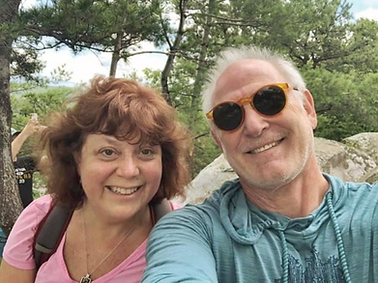
Rick Reiss shoots a selfie with his wife, Paula Kaplan-Reiss, during their hike on Monument Mountain on Aug. 10. Moments later Kaplan-Reiss fell 75 feet down a ledge from Squaw Peak, a rocky outcropping on the eastern face of the mountain.